Calisthenics · Updated 2026-09-16
Bodyweight training: the complete guide
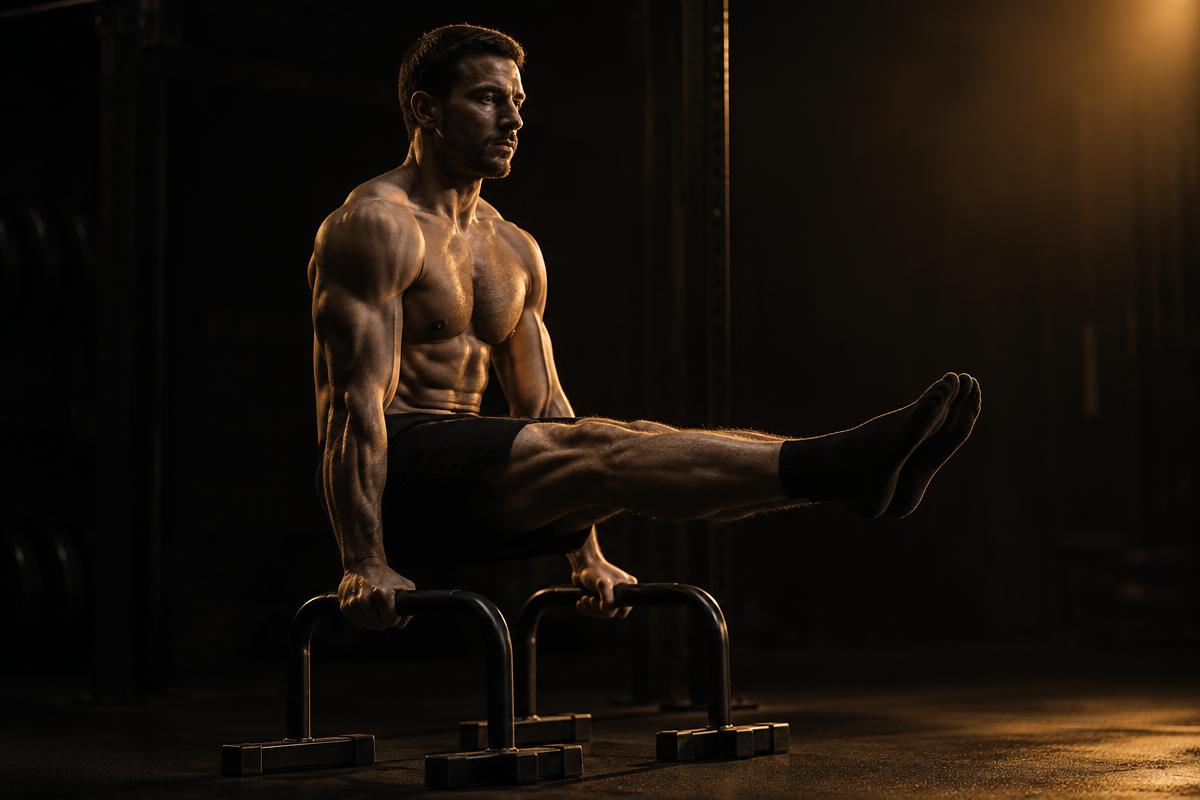
Bodyweight training is strength training that uses your own body as resistance instead of external weight. It builds strength and muscle through the same mechanism as weightlifting — enough tension close to failure — with difficulty added by changing leverage, removing support points or slowing tempo rather than adding kilos. It requires little to no equipment and scales from a first knee push-up to a one-arm pull-up.
How bodyweight training builds muscle without added weight
Muscle growth depends on mechanical tension applied close to fatigue, along with enough total volume over time. A barbell is one way to create that tension. Changing a push-up's leverage — elevating the feet, narrowing the hands, removing a second arm — creates exactly the same kind of tension using only your own mass.
This is why a one-arm push-up or a pistol squat can be far harder than lifting moderate weights: you are simply moving more of your bodyweight through a longer, less supported lever.
The core exercise families
- 01Push: push-up, dip, pike push-up, handstand push-up
- 02Pull: row, pull-up, chin-up, muscle-up
- 03Legs: squat, lunge, split squat, pistol squat
- 04Core: plank, hollow hold, L-sit, hanging leg raise
- 05Skills: handstand, front lever, planche, muscle-up
How progression works without adding weight
| Method | Example | Effect |
|---|---|---|
| Change leverage | Push-up → archer push-up | More bodyweight loaded on one side |
| Remove support | Two-leg squat → pistol squat | One limb carries the full load |
| Slow the tempo | 3-second lowering phase | Longer time under tension |
| Add instability | Floor rings instead of a bar | More stabiliser demand |
| Combine movements | Muscle-up instead of pull-up + dip | Strength through a full range |
A sample weekly plan
Three to four sessions a week, split by movement pattern, gives enough volume to build strength while allowing recovery between sessions targeting the same muscles.
- 01Monday: push (push-up variations, dips, plank)
- 02Wednesday: pull (rows, pull-ups, hollow hold)
- 03Friday: legs (squats, split squats, calf raises)
- 04Optional Saturday: skill practice (handstand, front lever tuck)
Where bodyweight training has limits
Leg strength is the main challenge: because legs are naturally strong, a basic squat stops being a training stimulus quickly, and harder single-leg variations require more balance and mobility to perform safely. This is where added resistance, such as a weighted vest or band, becomes genuinely useful for advanced lifters.
Following a bodyweight program with the right feedback
Because there is no visible weight increase to prove you are progressing, it is easy to plateau on the same variation without realising it. Calisthenics.dk's Movement Analyzer tracks your reps and form through the camera on your own phone, so progress and technique breakdowns are visible rather than assumed, and the Skill Tree lays out a clear next step for each movement pattern.
How the app helps you with this
Frequently asked questions
Is bodyweight training as effective as lifting weights?
For most people, upper-body pushing and pulling strength can be built just as effectively with bodyweight progressions. Leg training benefits more from added resistance once basic variations become easy.
Do I need any equipment at all?
A pull-up bar is the single most useful piece of equipment, since pulling movements are hard to progress without something to hang from. Everything else can be done with a floor and a wall.
How often should I train?
Three to four times a week, structured by movement pattern, works well for most people and allows adequate recovery.
Can beginners do bodyweight training?
Yes — every exercise has an easier variation, from wall push-ups to assisted squats, which makes bodyweight training one of the most accessible ways to start strength training.
Keep reading
Want the plan adapted to you?
Calisthenics.dk rebuilds the programme around your level, counts your reps through the camera and corrects your form as you go — all on your own phone.