Calisthenics · Updated 2026-09-16
Strength training at home: the complete bodyweight approach
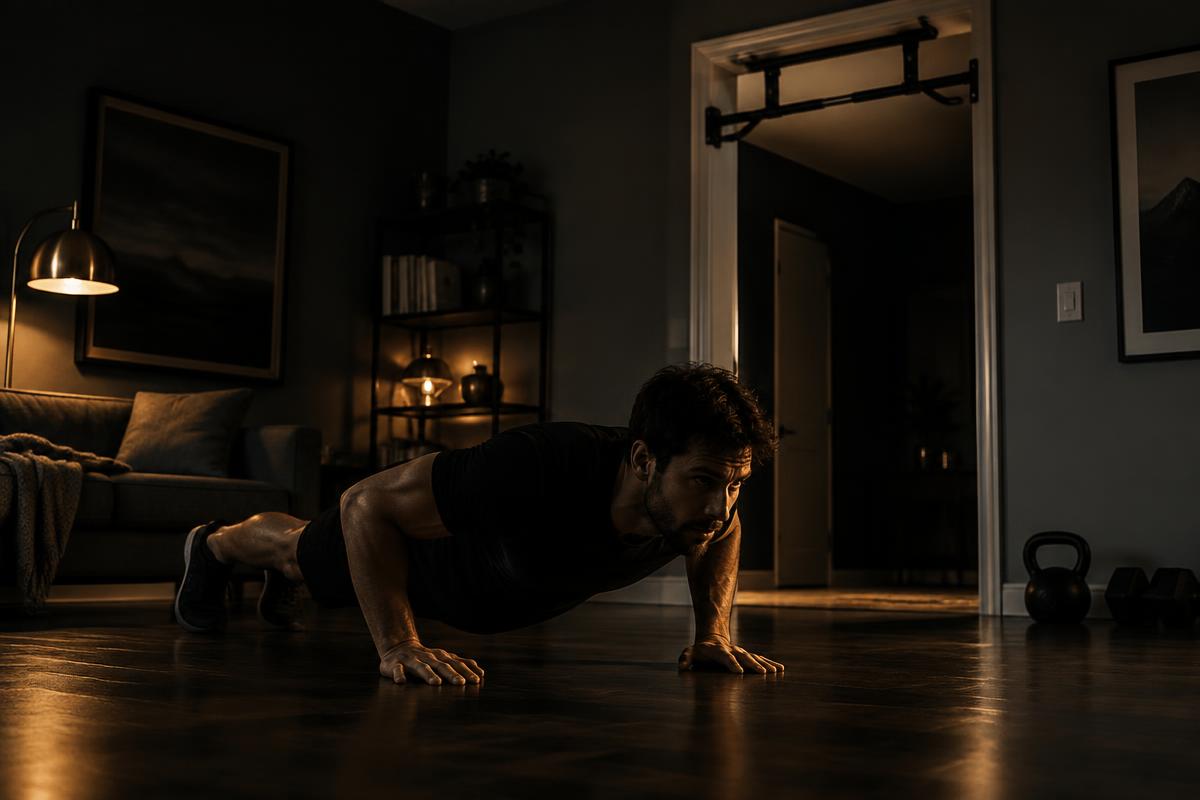
Strength training at home is fully possible with bodyweight exercises alone, provided you follow the same principle that makes a gym work: progressive overload. Choose a variation of each movement you can perform for 5-8 clean reps, train three to four times a week, add reps until you reach 12-15, then move to a harder variation. A pull-up bar is the one piece of equipment worth buying.
Can you actually get strong without weights?
Yes, and the mechanism is the same as in a gym: muscles respond to tension close to failure, regardless of whether that tension comes from a barbell or your own bodyweight. What changes is how you add difficulty — instead of adding kilos, you change leverage, remove support points, or slow the tempo.
The four movements that cover a full-body program
| Movement | Home exercise | Progression |
|---|---|---|
| Push | Push-up variations | Knee → full → diamond → archer → one-arm negative |
| Pull | Pull-up or row on a bar | Australian row → assisted → strict pull-up |
| Legs | Squat variations | Bodyweight → split squat → Bulgarian → pistol |
| Core | Plank and hollow hold | Plank → hollow hold → L-sit |
A simple weekly structure
Three sessions a week is enough to build strength consistently, and four allows a bit more specialisation. Keep sessions to 30-45 minutes including warm-up.
- 01Session 1: push-ups, dips or bench dips, plank
- 02Session 2: rows or pull-ups, glute bridge, hollow hold
- 03Session 3: squats, split squats, calf raises
- 04Session 4 (optional): full-body mix plus a skill like handstand practice
The one piece of equipment worth buying
Push and leg strength can be built entirely with the floor and a chair. Pulling strength is the exception — without something to hang from, back development stalls quickly. A doorway pull-up bar solves this for under the cost of a single month's gym membership.
When to make it harder
Move to the next variation once you can complete every set at 12-15 reps with clean technique. Staying on the same variation past that point wastes time; jumping too early sacrifices form. This rule alone accounts for most of the difference between people who plateau and people who keep progressing.
Tracking progress without a gym log
Without a coach watching your form, it is easy to let reps get shallower as you fatigue without noticing. Calisthenics.dk's camera-based Movement Analyzer counts your reps and scores depth and control on your own phone, and the AI Coach can suggest when to progress based on your actual training history rather than a fixed calendar.
How the app helps you with this
Frequently asked questions
Can bodyweight training build the same strength as weightlifting?
For upper-body pushing and pulling, yes, with enough progression to harder variations. Leg strength is harder to max out with bodyweight alone once you exceed roughly 20-30 reps on a basic squat.
How many days a week should I train at home?
Three to four days works well for most people, with at least one rest day between sessions targeting the same muscle group.
Do I need dumbbells at all?
No, though a pair of adjustable dumbbells or a resistance band can extend leg training once bodyweight squats become too easy.
How much space do I need?
A few square metres of floor and enough ceiling clearance for a doorway pull-up bar covers the entire program.
Keep reading
Want the plan adapted to you?
Calisthenics.dk rebuilds the programme around your level, counts your reps through the camera and corrects your form as you go — all on your own phone.